Everything You Need to Know to Use Svg on Website
Westith the growing number of screen resolutions, devices that support an internet connectedness (desktop computer, laptops, but as well tablets, mobile, TVs, and even your fridge someday), flexibility and scalability has become more and more important for websites. With the new inflow of the MacBook Pro Retina, this went a stride further and brought an HiDPI display that was unknown to the market place. This means a whole new challenge for spider web designers who take to find new ways to handle and make images size more flexible to avoid blurry rasterized effects. In this article, we will see how the SVG-format tin can assist us solve this challenge, using an everyday case of a website header with a clickable logo.
My personal roadmap to this projection: What I wanted to attain
From a UX / lawmaking point of view, I wanted two things for my logo:
- Since it'south the logo of my brand, I wanted it to exist clickable so that users can easily become back to the homepage
- I'm a prissy daughter and don't want to penalize people with older browsers, and so I wanted to provide some PNG-fallback for our older friends. If possible, the fallback should work without JavaScript.
Taking a look at these two things, I ran some tests and plant a few different code variants to achieve this result. They proved non every bit successful though. Following I'll show you how good the alternatives will perform.
Here is a visual of what we will build:

Yous can meet a demo hither, or fork the code on github
You lot can take a look at this tabular array to meet the SVG support in browsers.
The SVG logo: what is this format, and how did I create it?
SVG stands for Scalable Vector Graphics. Information technology is a markup language that enables us to create ii-dimensional graphics that are fully scalable. It is based on an XML syntax, and then you can create and open up an SVG file in a text editor. Don't panic, you lot don't need to exist a hardcore developer to do so. http://raphaeljs.com/, for example, is a very nice library to generate SVG images in an easier way.
If you lot're a designer, you can use your favorite pattern software to create SVG files. Illustrator and Inkscape volition do the task nicely and even Fireworks has a trivial plugin http://fireworks.abeall.com/extensions/commands/Export/ for this job.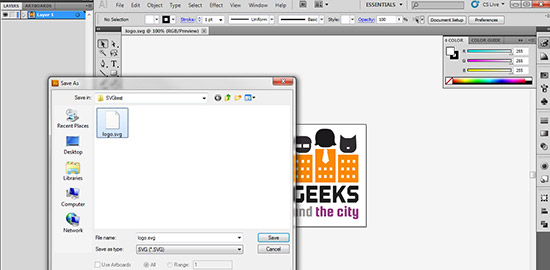
Save a SVG logo with Ilustrator using save equally > svg inside the format dropdown
Just call up a few rules when creating an SVG logo:
- Don't utilize complex illustrator gradients, only linear and radial ones
- Don't utilize the photoshop furnishings provided in Illustrator
- Be careful and name layers and group layers
- Ever merge shapes in the end when using pathfinder.
- Transform text into vectors shapes to make sure the upshot will work on devices that don't take the font.
To sum it up : Keep your SVG cartoon as uncomplicated as possible, export it, and exam in dissimilar browsers to run across the consequence.
For my example, I'm using a simple SVG-logo with no gradients and patently colors. (Many thanks to Geeks and the City for letting me kindly use their logo in this example. The logo is their property, I simply use it for the example with their consent. You tin can re-use the code for your projects, only not the logo.)
i. The < object > embed solution
This is the historical solution to embed SVG in webpages. The large advantage of this method is that the fallback is piece of cake to provide, you simple have to add the .png image in an img tag :
Run across demo
The code :
<a href="#" > <object class="logo" information="https://world wide web.noupe.comhttps://world wide web.noupe.comhttps://www.noupe.comhttps://www.noupe.comlogo.svg" width="186" tiptop="235" type="epitome/svg+xml"> <img src="https://www.noupe.comhttps://www.noupe.comhttps://www.noupe.comhttps://www.noupe.comlogo.png" width="186" height="235" alt="Logo Geeks and the City" /> </object> </a>
Pros:
- The fallback is elementary to provide
- The fallback does not rely on JavaScript
Cons :
- The link is non displayed on browsers that support SVG, you have to add a display: block to the link. Then the link is hidden "behind" the SVG object, then you tin can't click on the logo but around it
- Mod browsers with SVG support will download both files SVG and PNG
ii. The <svg> tag solution with foreignObject as fallback
Since HTML5, you lot can use a the new <svg> tag. Recollect when I said that SVG was a markup, yous can simply copy the markup within the SVG tag. All you take to do is open the .svg logo in a text editor, and copy paste the code.
In the foreignObject, we will include an img-tag with the .png fallback
See demo
The code
<a href="#svg_technique" > <svg class="logo" width="186" height="235"> <yard id="nyt_x5F_exporter_x5F_info"> </g> <thou id="nudged"> <path style="fill:none;stroke:#000000;stroke-miterlimit:10;" d="M46.397,121.92"/> …… <foreignObject width="0" height="0" overflow="hidden"> <img src="https://world wide web.noupe.comhttps://world wide web.noupe.comhttps://world wide web.noupe.comhttps://www.noupe.comlogo.png" width="186" top="235" alt="Logo Geeks and the City" /> </foreignObject> </svg> </a>
Pros
- The link now works
- The fallback works without JavaScript activated
Cons :
- Due to the copy/pasting of the SVG code, this technique is not very flexible, specially for logos. Every time yous change information technology, you take to upload the code
- Not all browsers implement the syntax correctly since information technology's pretty new
three. The <img> solutions, with different fallbacks
A last way of embedding SVG files is to use the img-tag. Note that the tag was not created for this purpose, so you lot might encounter bug if you lot apply many JavaScripts to modify your SVG object.
a. The <img> solution with JavaScript on mistake-fallback
Credits where due, I found this technique on Tavmjong Bah's blog (a great read if you lot want to go deeper into the SVG manipulation techniques using JavaScripts). This solution suggests using the error handler to detect the SVG back up, and supervene upon the .svg by a .png logo when the browser does not support SVG and triggers and error.
Come across the demo
The lawmaking
<a href="#catching_error" > <img class="logo" src="https://www.noupe.comhttps://www.noupe.comhttps://www.noupe.comhttps://www.noupe.comlogo.svg" alt="A sample SVG push." width="186" elevation="235" alt="Logo Geeks and the City" onerror="this.removeAttribute('onerror'); this.src='https://www.noupe.comhttps://world wide web.noupe.comhttps://www.noupe.comhttps://www.noupe.comlogo.png'" /> </a> Pros
- The link works pretty well
- The code is very simple and we merely need one img-tag
Cons
- The fallback relies on JavaScript and does not piece of work if deactivated
b. The <img> solution with a CSS background fallback
For this technique, we will only provide the SVG epitome in the HTML, and instead use Modernizr to detect SVG back up. If the SVG is supported, the script volition add together a .svg class to the html, if not, it will add a .no-svg.
Encounter the demo
The HTML code
<a href="#modernizr_css_fallback" > <img class="logo" src="https://www.noupe.comhttps://www.noupe.comhttps://www.noupe.comhttps://www.noupe.comlogo.svg" width="186" superlative="235" alt="Logo Geeks and the Metropolis" /> </a>
The CSS code
/*** specific for fallbacks **/ #modernizr_css_fallback img.logo { brandish:none; } #modernizr_css_fallback a{ display:cake; width:186px; height:235px; background-image: url(https://www.noupe.comhttps://www.noupe.comhttps://world wide web.noupe.comhttps://www.noupe.comlogo.png); background-colour:transparent; text-indent:-999px; colour:transparent; margin:0 auto; } .svg #modernizr_css_fallback img.logo { display:cake; } .svg #modernizr_css_fallback a{ background: none; } This i gets a little tricky, let's explain information technology. In order to make this work without JS activated, we will not use the .no-svg form. First we volition hide the image for one simple reason: Internet explorer eight and browsers that don't back up SVG will otherwise brandish the championship of the img. If nosotros put the background on the img-tag, we will run into both the groundwork, and the alt-attribute displayed to a higher place.
Internet explorer shows the alt-tag on top of the background
Instead, we hide the image, and put the background PNG-file in the a-tag.
Now, if SVG is supported, we become the .svg class in the html-tag, and do it all the way effectually: Nosotros display the img-tag, with the SVG in it, and hide the CSS background of the a-tag.
Pros:
- The link works
- The fallback works without JavaScript
Cons:
- Non really a con, but we have to cheat and employ the background to the a-tag
- If JavaScript is deactivated, browsers that practise back up SVG will get the PNG-fallback.
c. The <img> method with modernizR SVG detection to provide data-fallback fallback
In this method, we will use the new HTML5 data-attributes to provide the fallback file, coupled with modernizr to swap the image for browsers that do not support SVG.
See demo
The HTML lawmaking:
<a href="#img_modernizr_js_remplacement_bis" > <img class="logo" src="https://www.noupe.comhttps://www.noupe.comhttps://world wide web.noupe.comhttps://www.noupe.comlogo.svg" alt="A sample SVG button." width="186" height="235" data-fallback="https://www.noupe.comhttps://www.noupe.comhttps://www.noupe.comhttps://www.noupe.comlogo.png" alt="Logo Geeks and the Urban center" /> </a>
The JavaScript code:
window.onload = function(){ if(!Modernizr.svg) { var imgs = $('img[data-fallback]'); imgs.attr('src', imgs.data('fallback')); } } Using modernizr, we detect the SVG-back up. If the SVG is not supported, we supercede our logo with a .png one, using JavaScript.
Pros
- The link works
- The code is simple and clear
Cons
- The fallback relies on JavaScript and does non piece of work if it is deactivated
d. The <img> method with JavaScript and < noscript > every bit fallback
Once again, we use the prototype-tag, but this time, we volition provide a noscript-tag with the .png-image in information technology, in case JavaScript is deactivated.
See demo
The HTML code:
<a href="#img_modernizr_js_remplacement_nojs"> <noscript><img course="logo" src="https://world wide web.noupe.comhttps://www.noupe.comhttps://www.noupe.comhttps://www.noupe.comlogo.png" alt="A sample SVG button." width="186" height="235" alt="Logo Geeks and the City" /></noscript> </a>
The JavaScript code
window.onload = part(){ if(Modernizr.svg) { $('#img_modernizr_js_remplacement_nojs .header a').html('<img src="https://world wide web.noupe.comhttps://www.noupe.comhttps://www.noupe.comhttps://world wide web.noupe.comlogo.svg" width="186" height="235" alt="Logo Geeks and the City"/>'); } else { $('#img_modernizr_js_remplacement_nojs .header a').html('<img src="https://www.noupe.comhttps://www.noupe.comhttps://world wide web.noupe.comhttps://www.noupe.comlogo.png" width="186" meridian="235" alt="Logo Geeks and the Urban center">'); } } Nosotros detect SVG-support, swap the epitome for the SVG-logo if supported, and the PNG if not.
Pros
- The link works
- Works with JavaScript desactivated
Cons
- If JavaScript is deactivated, browsers that support SVG will display the noscript PNG-fallback.
Going further: font-icon and htaccess-trick for the road
In this article, I did not mention the font-icon embedding-technique. You can see the Icon Fonts are Awesome page to have a piffling demo, and observe a nice list of icons hither. I did not use this technique, because I idea information technology was not very appropriate and creating a font just for a unproblematic logo was maybe "too much". Also, logos should be images (in the wild sense, I include SVGs into images here), and then using a font-icon for a logo on a website was not a solution in my opinion.
Also note that yous might accept to declare the SVG-format in the .htaccess and so that the server delivers the correct header. You lot can practise so by adding this to the .htaccess:
AddType prototype/svg+xml svg svgz AddEncoding gzip svgz
More on SVG-usage from around the spider web:
- Using SVG graphics today
- An SVG Button Exam Page
- Resolution Independence With SVG
Conclusion
In this commodity, we saw different techniques to embed a SVG-logo, with a link dorsum to the homepage of the site. I'yard not telling you that ane method is amend than the other, you volition have to choose. At the moment, I'yard using the last solution on the alive website I did this research for, but that'due south merely personal preferences. There must besides exist other solutions to accomplish this and I would exist glad to hear well-nigh how you manage this claiming, then don't hesitate to share your results in the comments! So, will yous try to use some SVG logos on your website before long? What is your favorite technique?
(dpe)
This commodity is originally published on Sep 10, 2012, and updated on Jul 22, 2020.
chidesterdaris1967.blogspot.com
Source: https://www.jotform.com/blog/svg-clickable-71346/
0 Response to "Everything You Need to Know to Use Svg on Website"
Post a Comment